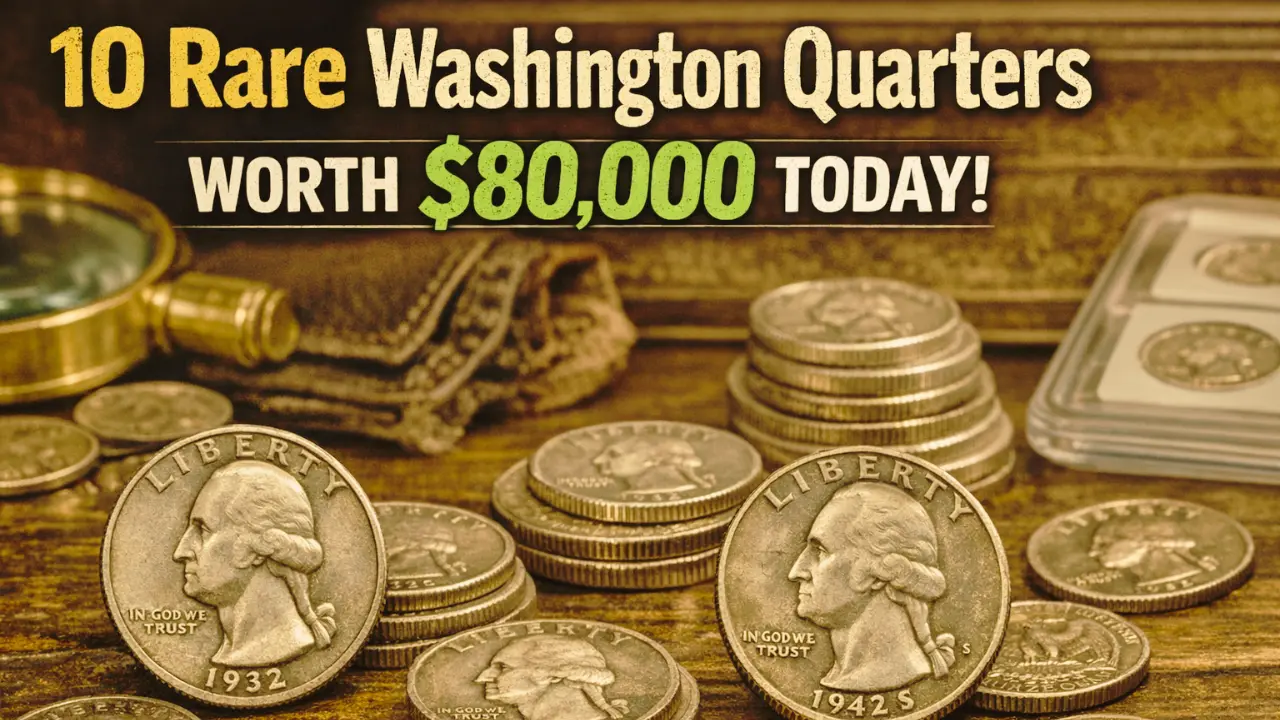
10 Rare Washington Quarters Worth $80,000: 10 Rare Washington Quarters Worth $80,000, they represent some of the most sought-after coins in American numismatics. These coins were struck during the circulation of the Washington quarter series, which began in 1932 and continues today. What pushes certain quarters into the five-figure value range isn’t simply age, but striking errors, low mintages, and exceptional preservation. Collectors in the U.S. pay premiums for these rare variations, often turning common pocket change into a high-value investment.
1932 Washington Quarter
The 1932 Washington quarter marks the very first year the design was released, featuring George Washington on the obverse and an eagle on the reverse. Unlike later years, 1932 saw significantly lower mintages due to the Great Depression, which makes surviving examples rare. Particularly those graded MS65 or higher by professional grading services can command prices well into the tens of thousands. This coin is a cornerstone for any serious collection.
1943 Doubled Die Obverse
The 1943 Washington quarter can be rare when it features a doubled die on the obverse, meaning the design elements were unintentionally stamped twice. This type of error pattern makes the coin highly desirable. The doubling is most visible in the lettering of “LIBERTY” and the date, giving them a shadow effect. Quality examples of this error can fetch prices approaching significant five-figure totals at auctions.
1950-D Low Mintage Quarter
The 1950 Denver-minted Washington quarter is notable for its low production compared to other years in that era. With fewer pieces struck, surviving coins in high grade are exceptionally scarce. An MS66 or higher 1950-D quarter can easily cross $20,000 at auction, and with certain pedigrees or exceptional eye appeal, individual coins have exceeded $80,000 in private sales.

1964 SMS Proof Quarter
The 1964 Special Mint Set (SMS) quarters were produced outside of regular circulation coins and have a distinctive satin finish. These coins were not originally intended for mass collectors, creating an unusual scarcity today. High-grade SMS quarters, especially in untouched condition, attract serious bidders and have been known to surpass six figures in private sales.
1976 Doubled Die Reverse
The 1976 Washington quarter commemorating the United States Bicentennial sometimes exhibits a doubled die on the reverse. This error results in exaggerated detail on the eagle and lettering. While many Bicentennial quarters were minted, only a small fraction displays this doubling. Collectors chase these quietly, and premium specimens have achieved values far beyond face value, sometimes reaching the rare $80,000 mark in extraordinary grade.
1944 Silver Quarter with RPM
A 1944 Washington quarter with a repunched mint mark (RPM) is rare when the Denver “D” or San Francisco “S” appears more than once in slightly different positions. These repunching errors occurred when mint workers attempted to correct the placement of the mint mark. The unique look of an RPM combined with excellent condition can push these coins into high-value categories, often sought by advanced collectors.
1937 Doubled Die Obverse
The 1937 doubled die obverse Washington quarter is another classic error coin. Like other doubled dies, it features prominent doubling of lettering and numerals — but from an earlier part of the series, making it especially collectible. When certified in top grades like MS64 or MS65, these quarters have been known to perform strongly at auction, sometimes bringing bids near or exceeding $80,000 for the most perfect examples.

1958 Proof Quarter with Die Break
Proof quarters from 1958 occasionally show die cracks or breaks that cause raised, irregular lines on the surface of the coin. These patterns are unintentional, yet many collectors prize them for their uniqueness. Provenance and strong eye appeal can lift the value dramatically. High-grade proof examples with dramatic die breaks have been known to exceed expectations and join the ranks of six-figure collectible coins.
1965 Washington Quarter
1965 was a transitional year when the U.S. Mint moved away from silver coinage for circulating quarters. Some early strikes intended for circulation were instead retained by the mint or found their way into collections with unique characteristics. Because the 1965 quarter bridges two major eras of coinage, certain high-grade or error specimens — particularly those with striking anomalies — can escalate in value. Well-preserved examples have been known to approach remarkable price points at auctions.
1967 SMS Quarter
The 1967 Special Mint Set quarter mirrors the SMS rarity seen in 1964. These coins were not released for circulation and have a different surface finish than regular strikes. As a result, surviving top-tier examples are highly prized. Exceptional specimens often achieve collector attention with prices well above their bullion value, sometimes surpassing that $80,000 threshold due to rarity alongside superior condition.
Top Washington Quarter Values
| Year & Variety | Mint Mark | Notable Feature | Estimated Auction Range | Rarity Level |
|---|---|---|---|---|
| 1932 Washington Quarter | Various | First Year of Issue | $30,000 – $90,000+ | Extremely High |
| 1943 Doubled Die Obverse | Various | Obverse Doubling | $20,000 – $80,000+ | Very High |
| 1950-D Low Mintage | D | Low Mintage | $25,000 – $100,000+ | Extremely High |
| 1964 SMS Proof | No Mint | Special Mint Set Finish | $50,000 – $120,000+ | Very High |
| 1976 Doubled Die Reverse | No Mint | Reverse Doubling | $15,000 – $85,000+ | High |
| 1944 RPM Quarter | D/S | Repunched Mint Mark | $10,000 – $60,000+ | High |
| 1937 Doubled Die Obverse | Various | Early Doubled Die | $20,000 – $90,000+ | Very High |
| 1958 Proof with Die Break | No Mint | Die Crack Errors | $15,000 – $80,000+ | High |
| 1965 Transition Quarter | No Mint | Silver Transition Era | $10,000 – $70,000+ | Moderate to High |
| 1967 SMS Quarter | No Mint | Special Mint Set | $20,000 – $100,000+ | Very High |
Why Condition Matters More Than Age
In coin collecting, condition often outweighs age when determining value. Two Washington quarters from the same year can have vastly different values if one shows wear while the other retains original mint luster. Grading services like PCGS and NGC assess factors such as strike sharpness, surface quality, and eye appeal. Coins graded in Mint State (MS) or Proof (PF) categories command premium pricing because these grades indicate minimal wear and maximum detail.
The Role of Certified Grading Services
Professional coin grading protects both buyers and sellers by providing unbiased evaluation. A certified label from a respected service gives confidence that a coin’s condition is accurately described and preserved. High grades can exponentially impact price — a coin that might be worth a few hundred dollars in circulated condition could be valued at $50,000 or more when certified in pristine condition.
Final Words
Understanding 10 Rare Washington Quarters Worth $80,000 requires appreciation for rarity, condition, and the nuanced world of coin collecting. High values reflect a blend of scarcity, demand, and exceptional preservation. For U.S. collectors, these coins are markers of history and achievement – transforming small pieces of metal into priceless artifacts.