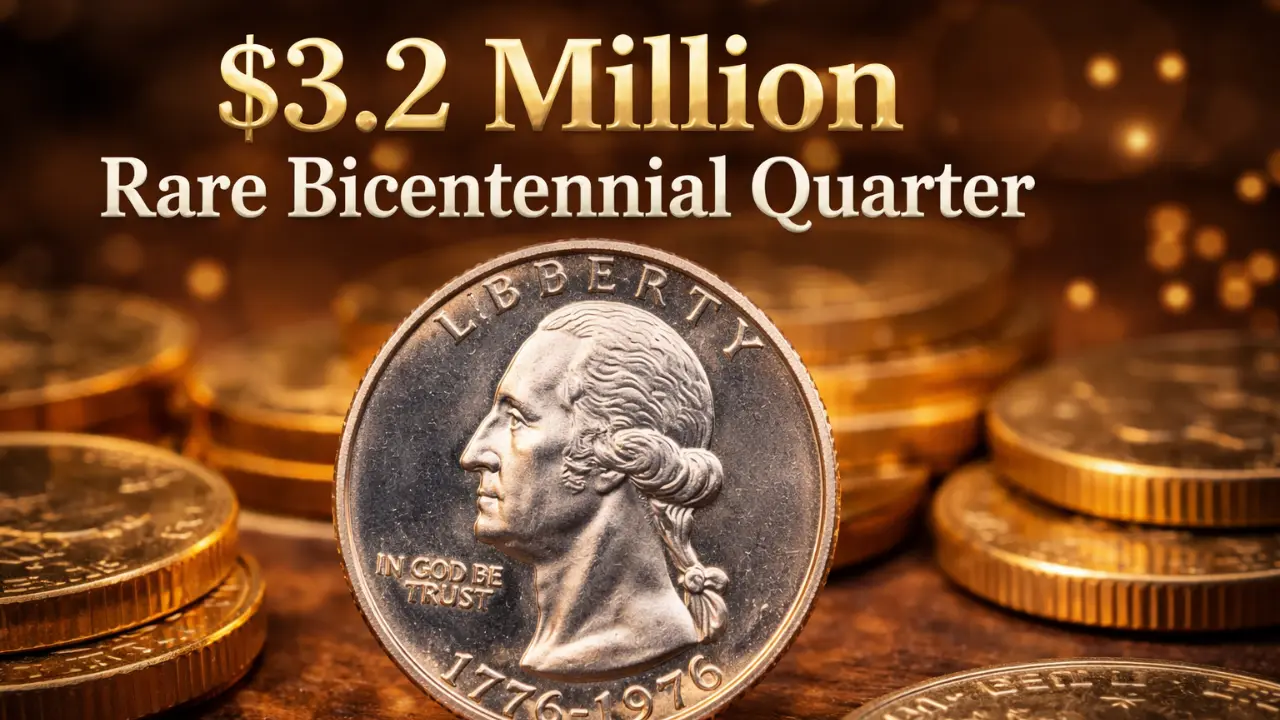
$3.2 Million Rare Bicentennial Quarter: The rare $3.2 million Bicentennial Quarter has become one of the most sought-after names in the world of U.S. coin collecting. The Bicentennial Quarter was issued in 1975–1976 to commemorate America’s 200th anniversary, and millions were minted. Most are worth only face value or a few dollars. However, due to their rarity, unique minting characteristics, pristine condition, and unique metal composition, some exceptional coins have sold for or are estimated to be worth millions. These high-value specimens transform an everyday pocket coin into a historical treasure.
The History Behind the Bicentennial Quarter
The Bicentennial Quarter was created as part of a special redesign program approved by Congress to honor the nation’s 200th birthday. Instead of the usual eagle, the obverse features a Colonial drummer and a torch surrounded by 13 stars. The obverse still features George Washington’s image, but it includes two dates: “1776–1976.” Over 1.6 billion Bicentennial quarters were produced at multiple mints, making them common overall. Yet, within this large production, some rare varieties stand out from the rest.
Why is a Bicentennial quarter worth millions?
Not every Bicentennial quarter is worth a fortune. Coins worth $3.2 million have certain unique features that set them apart from common coins. These features include experimental metal composition, rare minting errors, and flawless preservation. When several premium factors combine, collectors are willing to pay a lot. Just being rare isn’t enough. A coin must also demonstrate strong demand, verified authenticity, and historical significance.
The Role of Metal Composition in High Prices
Most Bicentennial quarters were struck from copper-nickel clad metal. A small portion was struck in 40% silver for collector sets. However, some very rare specimens are believed to have been struck on experimental or transitional planchets. These may include silver blanks made for other denominations or special test metals that were never released to the public. A Bicentennial quarter accidentally struck on an unusual planchet and kept in perfect condition can command a very high price due to its uniqueness.

Minting Mistakes That Drive High Prices
Minting mistakes are a major reason behind million-dollar valuations. Double die strikes, off-metal strikes, and wrong-planchet errors significantly increase their appeal. Some rare Bicentennial quarters exhibit significant doubling in the lettering and drummer design, while others were struck on blanks intended for foreign coins or other U.S. denominations. When these errors are significant, clearly visible, and confirmed by experts, the market considers them elite-level collectibles.
The Importance of Coin Condition
Condition plays a significant role in valuation. A coin with a rare error in worn condition can fetch thousands, while the same coin in perfect condition can fetch millions. Coins graded at the highest level show no wear, sharp detail, original luster, and a perfect surface. The rare Bicentennial quarter worth $3.2 million belongs to specimens graded at the near-perfect or perfect level, making them museum-quality pieces.
Professional Grading and Authentication
High-priced coins should be professionally graded and authenticated. Independent grading services analyze weight, metal composition, strike quality, surface condition, and originality. Without certification, a coin claiming million-dollar status has little credibility. Certified coins are sealed in tamper-proof holders and assigned numerical grades. This process protects buyers and sellers and supports record-breaking price levels.
Collector Demand and Market Psychology
The U.S. rare coin market is driven by history, competition, and prestige. Wealthy collectors often seek “trophy coins” that few people can possess. A unique Bicentennial quarter associated with a major historical event fits this category perfectly. When multiple collectors covet the same ultra-rare coin, bidding wars can drive prices into seven figures. A valuation of $3.2 million illustrates this high-stakes competition.

How Rare Is a Million-Dollar Bicentennial Quarter?
Over a billion Bicentennial quarters were minted, and only a few are worth a million dollars. Most collectors will never see such coins in person. These coins typically come from estate collections, old mint holdings, or long-forgotten storage. Their scarcity is a key reason prices can reach such high levels.
Estimated Value Range by Type
| Bicentennial Quarter Type | Estimated Value Range |
|---|---|
| Regular Circulated Coin | $0.25 – $1 |
| Uncirculated Clad Coin | $1 – $5 |
| 40% Silver Version | $10 – $50 |
| Minor Error Coin | $100 – $5,000 |
| Major Error / Rare Planchet | $50,000 – $500,000 |
| Ultra-Rare Museum-Grade Specimen | Up to $3.2 Million |
Investment Perspective
Ultra-rare coins operate in a different financial world than ordinary collectibles. Prices are determined by rarity, certification, provenance, and long-term collector interest. While not every rare coin appreciates in value, historically significant U.S. coins with unique features have shown good long-term value growth. The rare $3.2 million Bicentennial quarter tops this niche investment category.
Why This Coin Attracts People’s Attention
The idea that a seemingly ordinary quarter could be worth millions captivates people. It highlights the hidden difficulty of coinage and the importance of small details. Stories about rare Bicentennial quarters encourage people to pay more attention to everyday items, even though the chances of finding a million-dollar example are slim.
Final Words
The rare $3.2 million Bicentennial quarter represents a perfect combination of historical significance, extreme rarity, unique minting characteristics, and perfect condition. While most Bicentennial quarters remain common, some have achieved legendary status in the U.S. coin market. These unique coins remind collectors that even mass-produced items can contain true treasures.