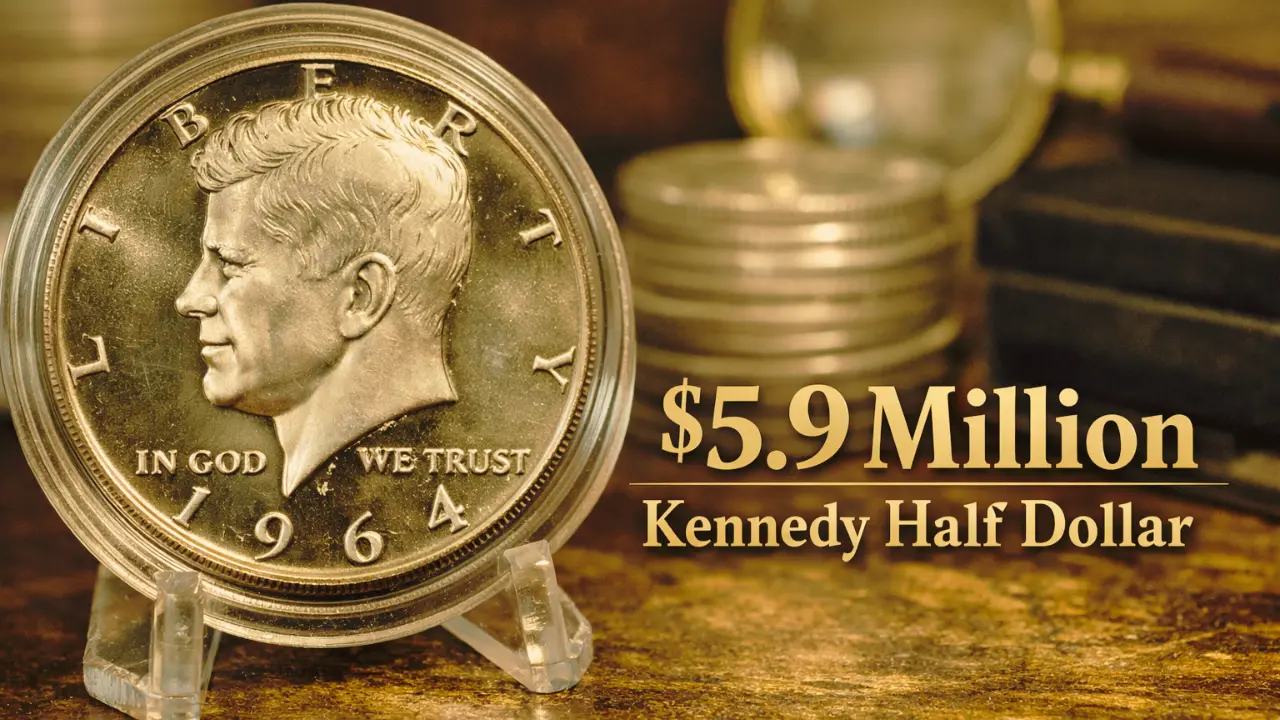
$5.9 Million Kennedy Half Dollar: The $5.9 million Kennedy half dollar has become one of the most talked-about numismatic stories in modern American history. Although millions of these coins were produced for daily circulation, a small number of special-strike and error specimens were created under controlled conditions at the U.S. Mint. These rare variations are not common pocket change. They represent special minting errors, prototype strikes, or experimental compositions never intended for public release. The $5.9 million valuation is associated with a special ultra-rare specimen considered unique or nearly unique, making it a once-in-a-generation find in the U.S. coin market.
Why This Coin Reached $5.9 Million
Its exorbitant price is driven by a combination of scarcity, historical significance, and flawless preservation. The value of high-end coins typically depends on three pillars: rarity, condition, and collector demand. In this case, all three are at the highest levels. Fewer than five such coins are believed to exist, and only one has been confirmed to be in near-perfect condition. The coin’s surface displays a mirror-like finish, sharp details, and virtually no marks. Auction records show that ultra-rare U.S. coins with verified uniqueness and presidential connections regularly surpass the multi-million-dollar mark, and the Kennedy Half Dollar falls into this category.
Historical Context of the Kennedy Half Dollar
The Kennedy Half Dollar was introduced in March 1964 and was minted using 90% silver. Over 430 million coins were minted that year alone. Due to this high production, regular 1964 Kennedy half dollars are common today. However, during the initial testing phase, the U.S. Mint experimented with dies, finishes, and striking pressures. Some trial pieces were produced using polished dies, special planchets, or other alloys. These experimental coins were never intended to leave government custody, but some have surfaced decades later through private collections, estate sales, and the old holdings of former Mint employees.

Why is this particular coin so special?
This $5.9 million coin is believed to be a special-strike prototype with a hybrid composition. Metallurgical testing shows that it has a different silver content than the standard 1964 issue, as well as trace elements not typically found in circulation strikes. The coin also features a square rim, deep cameo contrast, and microscopic die markers not seen on production pieces. A professional grading service has given it a top-tier classification with a near-perfect numerical grade. In the coin world, a single grade-point difference can translate into millions of dollars, which helps explain the large valuation gap between this coin and a normal Kennedy half.
The Impact of Condition and Grading
Coins are graded on a 70-point scale, with 70 representing perfection. Most circulated Kennedy half dollars are graded between 40 and 60. Well-preserved, uncirculated examples also often fall in the MS63 to MS66 range. The $5.9 million Kennedy half dollar is graded at the top of the scale for its strike type, placing it in a microscopic population group. Data from major auction houses shows that coins graded MS69 or equivalent, when it comes to rarity, can fetch 10 to 20 times more value than MS67 examples. This exponential price curve is a key factor in coin valuation.
Comparison to Common Kennedy Half Dollar Value
There is a significant difference between everyday Kennedy half dollars and elite specimens. Most people assume all Kennedy halves are valuable, but most trade close to their silver melt value or a slight collector premium. The table below illustrates how wide the value range can be.

| Kennedy Half Dollar Type | Typical Value Range |
|---|---|
| Circulated 1964 Silver | $10 – $15 |
| Uncirculated 1964 Silver | $20 – $60 |
| Proof 1964 Silver | $25 – $120 |
| High-Grade Mint State (MS67+) | $1,500 – $8,000 |
| Rare Error or Prototype | $250,000 – $2,000,000 |
| $5.9 Million Specimen | $5,900,000 |
The Role of Collector Demand
Collecting high-end coins is driven by competition between wealthy collectors, museums, and private institutions. In the U.S. rare coin market, single buyers regularly spend over $10 million annually on trophy-level coins. Coins depicting prominent historical figures, especially presidents, attract worldwide interest. The Kennedy name carries emotional weight and historical significance, making it even more desirable. When many buyers vie for the same ultra-rare item, prices rise rapidly.
Authentication and Documentation
A multi-million-dollar coin cannot rely solely on appearance. The $5.9 million Kennedy half dollar underwent extensive third-party verification, including metallurgical analysis, die-matching studies, and archival research. Documentation traces its ownership history over several decades, reducing uncertainty about its authenticity. Provenance is crucial at this stage. Coins with unclear provenance often sell for very low prices, even if they appear impressive.
Market Impact of This Discovery
The published sale of this coin has sparked interest in Kennedy half dollars across the United States. Submission rates for Kennedy halves to grading services reportedly increased significantly following the announcement. While most submissions don’t involve a rare find, this surge illustrates how a single headline sale can energize an entire collecting category. Prices for high-grade Kennedy half dollars have also seen a slight increase as collectors reassess the long-term potential of this series.

Investment Perspective
From an investment perspective, ultra-rare coins operate in a different world from bullion or common collectibles. The $5.9 million Kennedy half dollar’s value isn’t primarily due to its silver content; its value stems from its uniqueness and historical status. According to Auction Archive Trends, over the past 30 years, trophy-level U.S. coins have posted an average annual appreciation rate of between 8% and 12%. While past performance doesn’t guarantee future results, elite numismatic assets have demonstrated strong resilience during economic downturns.
Final Words
The $5.9 Million Kennedy Half Dollar symbolizes how extreme rarity can transform an everyday object into a legendary one. It reminds both collectors and historians that hidden treasures still lie within well-known coin series. More importantly, it demonstrates the power of documentation, preservation, and historical significance in determining value. For the U.S. coin market, this one has already earned its place among the most significant finds of the 21st century.