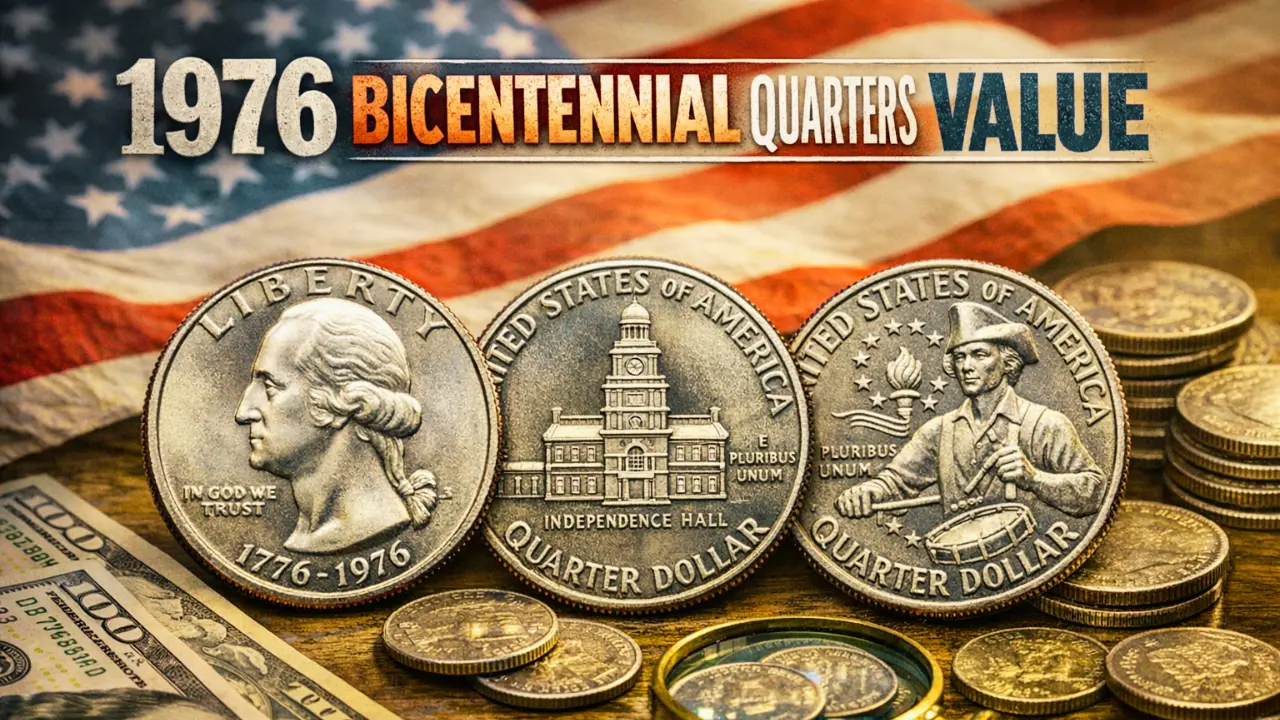
1976 Bicentennial Quarters Value: The value of 1976 Bicentennial Quarters is one of the most hotly debated topics among coin collectors and casual holders in the United States. This quarter was issued to commemorate the 200th anniversary of American independence, featuring a unique dual-date design with the inscription “1776-1976.” While most circulated pieces have a face value of 25 cents, certain conditions and mint variations have made some of these coins highly prized among collectors. Their value can range from the face value of a quarter to hundreds of dollars, depending on rarity and grade.
History of the Bicentennial Quarter
The year 1976 marked America’s Bicentennial celebration, which influenced many commemorative products, including coins. The U.S. Mint commissioned Jack L. Ahr’s Bicentennial quarter, which was created with a distinctive reverse design depicting a colonial drummer and a Victory torch surrounded by thirteen stars. This replaced the traditional eagle reverse that year. These coins circulated extensively, making most general issues highly sought after today. However, because mintages were so high (over one billion coins), only certain special coins now command a premium.
Mintage and Production Data
The 1976 Bicentennial quarters were struck at the Philadelphia (no mint mark), Denver (D), and San Francisco (S) mints. Total production numbers were very high: approximately 1.7 billion quarters entered circulation, and millions more were struck specifically for collector sets. Although these high numbers reduced the rarity of commonly circulated examples, San Francisco proof and uncirculated sets are in short supply and therefore have high collector value.
Main Design and Specifications
The coin’s size and metal composition were similar to the standard quarter of the era, using a copper-nickel clad composition. George Washington is immortalized on the obverse, while the reverse features patriotic elements symbolizing the country’s founding. The double date “1776-1976” makes these coins instantly recognizable and distinguishes them from other quarter issues. Specifications such as the 24.3 mm diameter and 5.67g weight were the same as the standard quarter.

Value of Circulated Coins
Most 1976 Bicentennial quarters in daily circulation remain at 25 cents. Because over a billion coins were minted for circulation, there is no significant premium over face value for common grades ranging from Good (G4) to Very Fine (VF20). Many uncirculated coins in circulation also typically have a value of $0.25 to $1.00, unless they have a special feature or a superior mint condition grading.
Uncirculated and Mint Set Premiums
Higher grades increase value. For example, a 1976 Bicentennial Quarter graded MS65 (Mint State) by a professional service like PCGS or NGC can fetch a collector premium. According to current collector data, MS65 grades typically trade for $5 to $15. Rare high-end grades like MS67 can reach $100 or more at auction due to collector demand. Mint sets issued from Denver or Philadelphia in the mid-1970s often command higher prices because they are better preserved than circulated examples.
Proof Coins and Their Value
The San Francisco Proof Issue of the 1976 Bicentennial Quarter, especially those minted in special sets with other Bicentennial coins, possess value beyond appearance. Proof coins have a glass-like surface and sharp details. Proof coins in standard proof condition typically fetch $3 to $10. Proof coins graded PR65 or higher can reach $20-$50, and rare PR70 Perfect Proofs are highly sought after by advanced collectors who value rarity and condition.
Errors and Variety in Market Demand
Errors and variety often have a much greater impact on the value of 1976 Bicentennial Quarters than the normal mintage. Well-known variations such as doubled dies, clipped planchets, or off-center strikes are examples where prices can reach hundreds or even thousands of dollars, depending on the severity and collector interest. The lack of standardization in early error reporting has made authenticated error coins particularly valuable in niche markets.

Market Trends and Recent Sales
According to recent auction data, well-graded 1976 Bicentennial quarters have attracted increased interest from collectors seeking high MS and Proof grades. A coin graded MS67 by PCGS can sell in the $75-$120 range at specialty auctions, reflecting a strong niche market. Proof coins graded PR69 or PR70 have also seen rising prices, sometimes exceeding $100 per copy when certified by a top grading service.
Comparison to Other Commemorative Coins
Many coin enthusiasts compare the 1976 Bicentennial Quarter to other U.S. commemorative coins, such as the 50 State Quarters or the America the Beautiful series. Even though these later series incorporate modern collector trends and technologies like clad core variations, the Bicentennial Issue’s historical significance remains. This context often determines the price of collectibles, as many modern collectors choose Bicentennial Quarters for their cultural and historical appeal.
Investment vs. Sentimental Value
Although 1976 Bicentennial Quarters may be valuable in the rare, high-grade, or error categories, most collectors consider these coins to be historical pieces. Circulated coins have little investment value beyond the face value, but carefully maintained examples offer both aesthetic appeal and a modest financial return over the long term. Since the U.S. Mint did not plan a specific rarity for this issue, so most coins in common grades offer more sentimental and educational value than investment value.
The Importance of Authentication and Grading
Professional grading is crucial when determining value. Coins authenticated by a service like PCGS (Professional Coin Grading Service) or NGC (Numismatic Guaranty Company) provide third-party verification of grade, authenticity, and rarity. Numerical grades, followed by grading scales like MS (Mint State) or PR (Proof), help create consistent pricing tables used in auctions and private sales. Uncertified coins often sell for significantly lower prices due to buyer confusion.
Common Prices by Grade
The table below shows the typical value ranges for common grade categories of 1976 Bicentennial quarters:
| Grade / Type | Typical Value Range (USD) |
|---|---|
| Circulated (G4 – VF20) | $0.25 – $0.50 |
| Uncirculated (MS60 – MS63) | $1 – $5 |
| High Uncirculated (MS65) | $5 – $15 |
| Very High MS (MS67) | $50 – $120+ |
| Standard Proof (PR65 – PR69) | $3 – $20 |
| Perfect Proof (PR70) | $100+ |
Final Words
The 1976 Bicentennial Quarters range in value from everyday pocket money to highly prized collectibles. Visual appeal, condition, and certification all play a role in determining value. For most Americans who find these coins out in the wild, they are more a memento of the nation’s heritage than a significant investment. However, collectors still actively trade high-grade and error coins at strong market levels, making these coins valuable even decades after their release.